Your notes already know
what you're worth.
SeekBridge is a personal recruiter that works from everything you've written. It finds the connections you never made, turns them into work you can use — white papers, resumes, cover letters — and ends every draft by pointing you to the next note worth writing. The more you use it, the more it finds.
Most of what you know is sitting in notes nobody reads — including you.
People who think for a living write constantly: essays, ideas, project plans, half-finished arguments at 2 a.m. That writing is the best record of what they can do. But it piles up in folders, scattered across subjects, and almost none of it ever becomes something another person sees.
The Archive Problem
Notes go in and never come back out. In one real vault of 1,500 notes, 69% of the 2,537 tags were used on exactly one note — the organizing system connected almost nothing.
The Connection Problem
An essay about management and a poem about the gym can be working the same question. Folders and tags sort by subject, so the patterns that run underneath your thinking stay invisible.
The Blank Page Problem
The ideas for a white paper are already in your notes, spread across thirty of them. Pulling them into one argument is the hard part, so it never gets written.
The Resume Trap
Your knowledge, skill, and aptitude can't be condensed into two pages. Most of your best work happens outside a job title — and the traditional resume has no way to carry it.
A loop, not a pipeline.
Most tools take your notes in and hand something back once. SeekBridge is recursive: what it drafts tells you what to write next, what you write gets connected on the next pass, and the new connections surface ideas that weren't visible before. Each turn of the loop leaves the vault richer than it found it.
- 01Capturewrite, paste, import
- 02Connectshared tags · threads
- 03Discovercross-subject bridges
- 04Draftpapers · resumes · letters
- 05Build from heregaps become new notes
Recursive, never self-referential. Drafts and generated notes are kept out of the evidence the system reasons from. The loop grows from your new writing — never from AI output feeding on itself, which is how generated text quietly turns into invented facts.
From a pile of notes to work you can publish.
SeekBridge works on a folder of plain Markdown files. Use Obsidian if you like — or don't; the app is a complete editor on its own.
Capture everything
Type a note, paste a wall of text and let AI Organize split it into tagged notes, import files, or bring in your LinkedIn export. Old Google Docs, poems, project plans — it all counts.
Add to Vault · AI Organize · File import · LinkedIn exportConnect what you've written
One pass builds a shared tag vocabulary from your own tags, merging synonyms, in four families: what a note is about, the question underneath it, the mental model it reasons with, and the tension it works through. The last three are what connect notes across unrelated subjects.
Vault Connections · topic / question / model / tension · re-runs only read changed notesSee the threads underneath
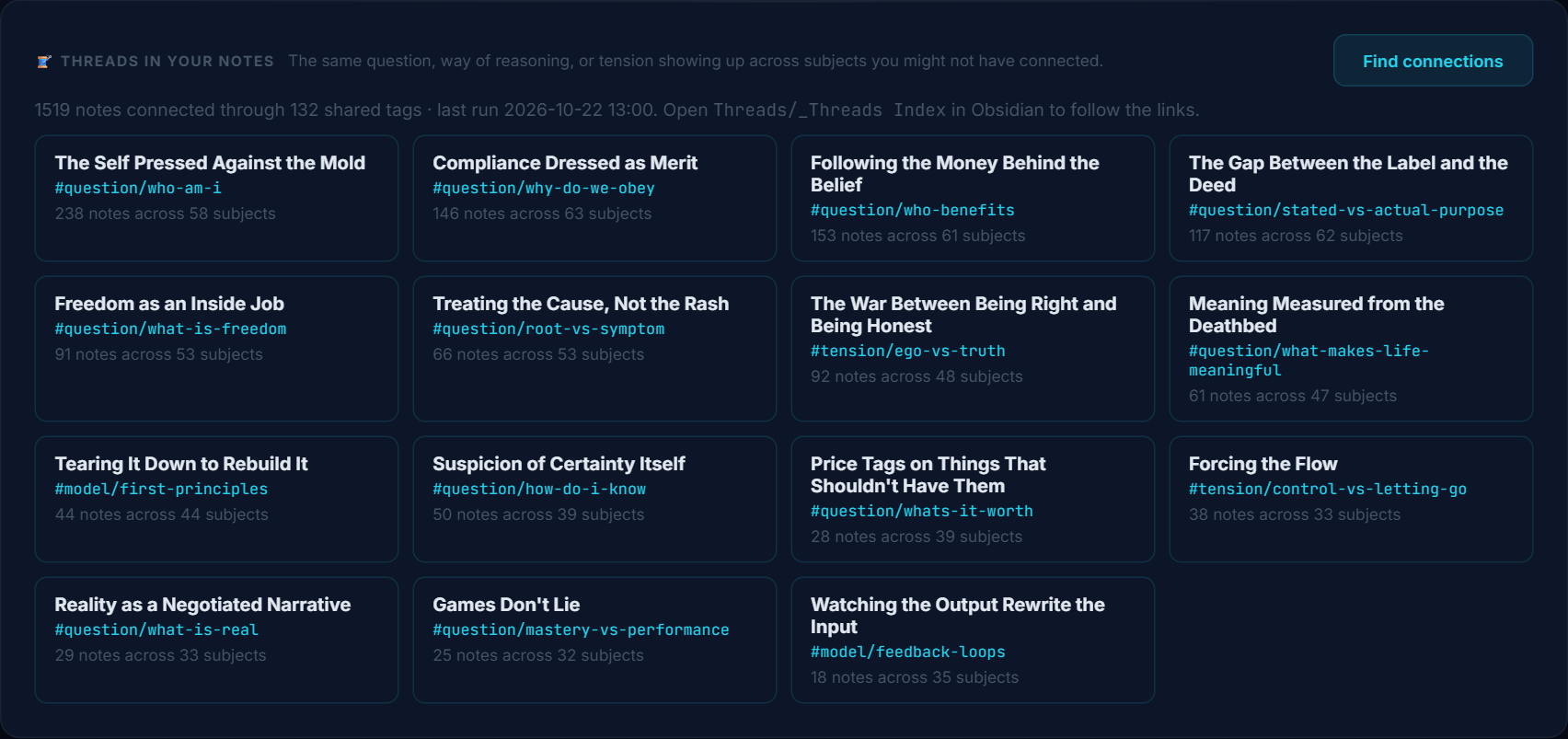
When the same question shows up across many unrelated subjects, it becomes a Thread: a note in your vault that names the pattern, shows where it appears, and asks the question your notes keep circling — with links to every note in it, so your graph shows the web.
Threads/ · open question per thread · Obsidian graph-ready linksDiscover the papers only you could write
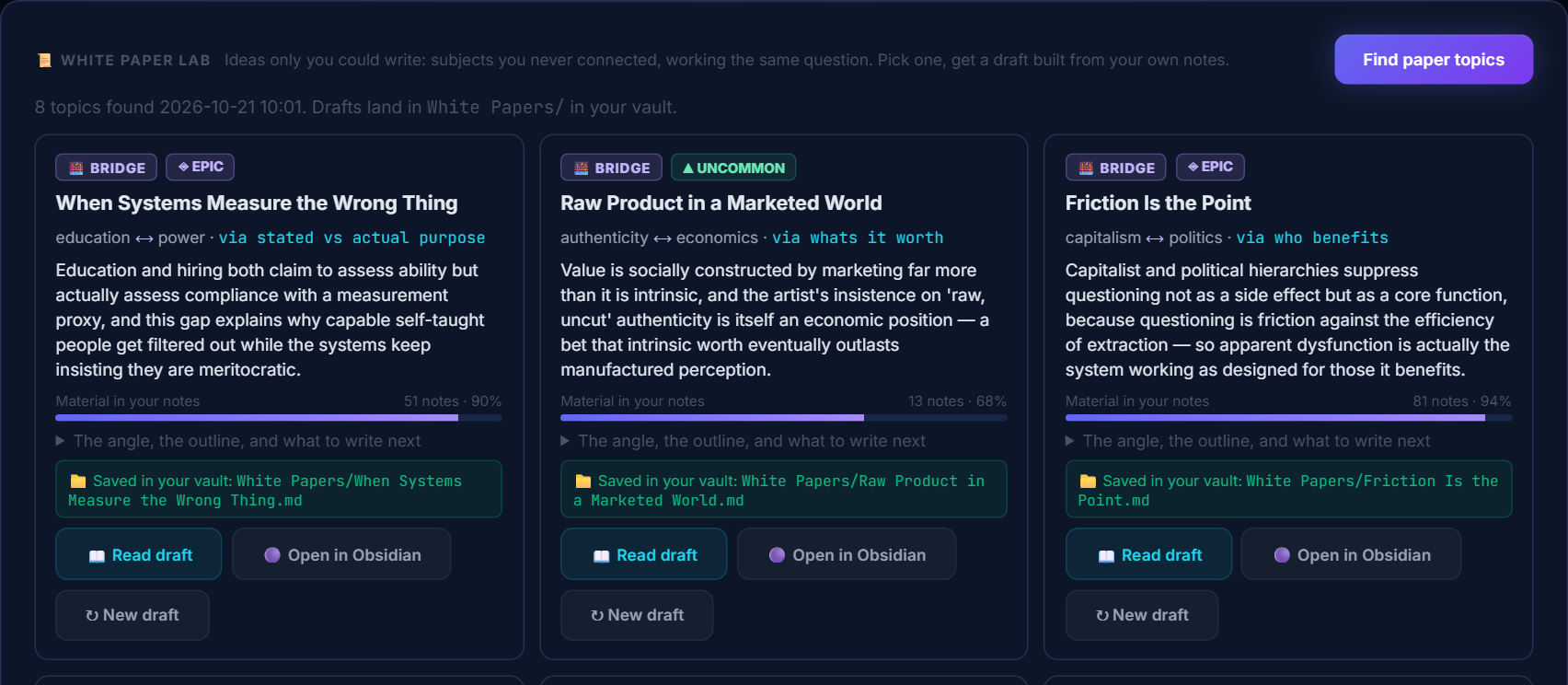
The White Paper Lab finds bridges: two subjects you rarely write about together that keep working the same idea. That overlap is an original angle. Each topic comes with a thesis, an outline, the notes behind it, and a meter showing how much material you already have.
Bridge + deep-dive scoring (free, local) · one AI call for proposalsDraft from your own words
Pick a topic and get a 2,000–3,000 word draft built from up to 30 of your notes. Every note it leans on is cited as a link. Anything that needs outside evidence is marked [citation needed] — nothing is invented. Each draft ends with Where This Breaks, Open Questions, and Build From Here.
Saved to White Papers/ · never overwrites · opens in Obsidian in one clickBuild from here — and go around again
Every topic lists the notes you should write next, as specific prompts. One click starts that note. The next connections pass folds it in, and the Lab flags that new topics may be waiting.
Gap prompts → Start note → reconnect → refreshed topicsPut it to work: get in front of people, then apply with proof
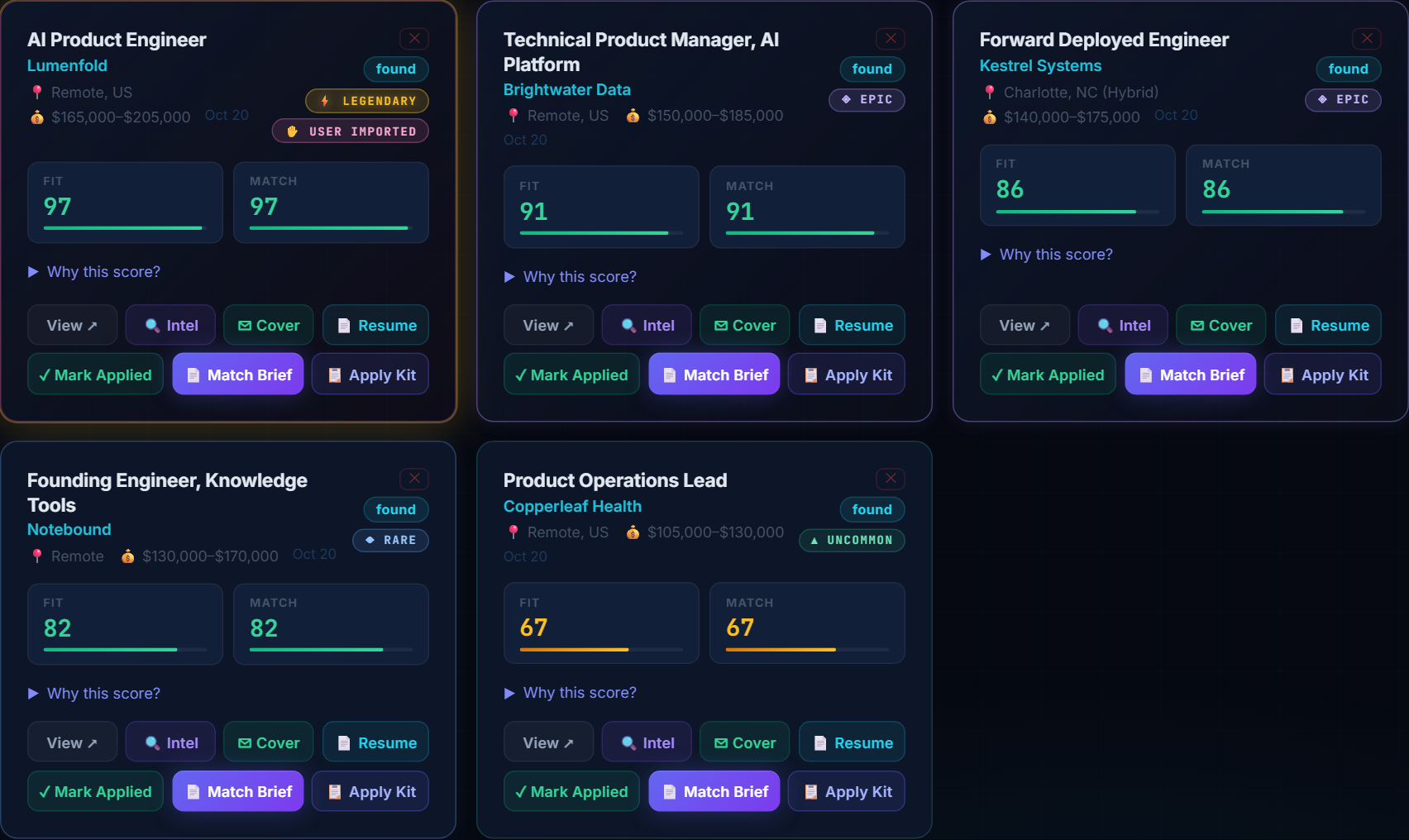
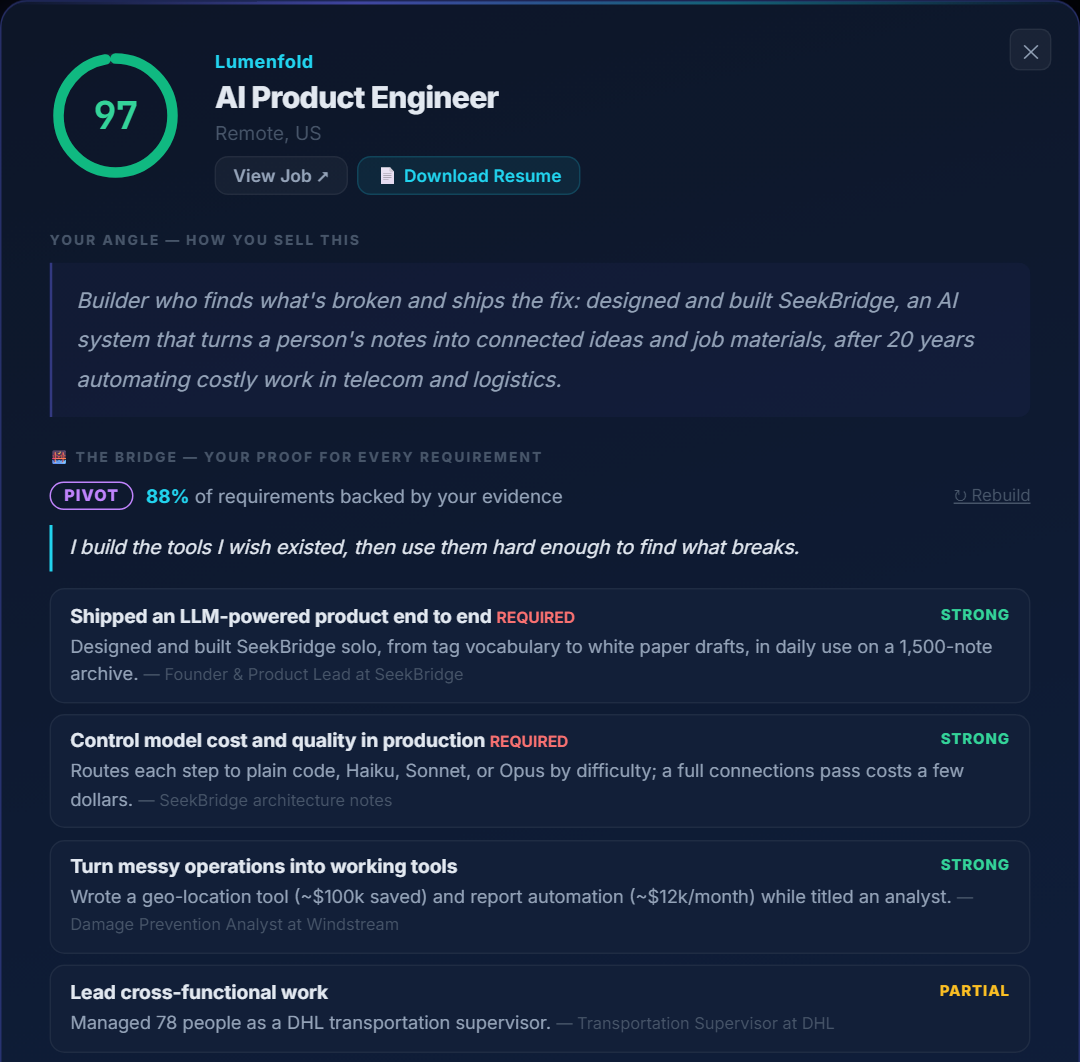
The same vault powers your search. For any role, SeekBridge builds an outreach kit: the warmest path in, a referral request, a LinkedIn note and DM, an email and follow-up, and a playbook for the week, all drawn from your real work. When you apply, the Job Bridge maps each requirement to your evidence and names the honest gaps, and resumes and cover letters come from what you actually did. Every message and application is sent by you.
Outreach kit · Fit scoring · Job Bridge · Match Brief · Interview prep · Smart Fill (you click submit)What it looks like in use.
Screens from the running app. The vault screens show my own notes. The job screens use example jobs at fictional companies, so no real applications are shown; the evidence in them is my actual background.
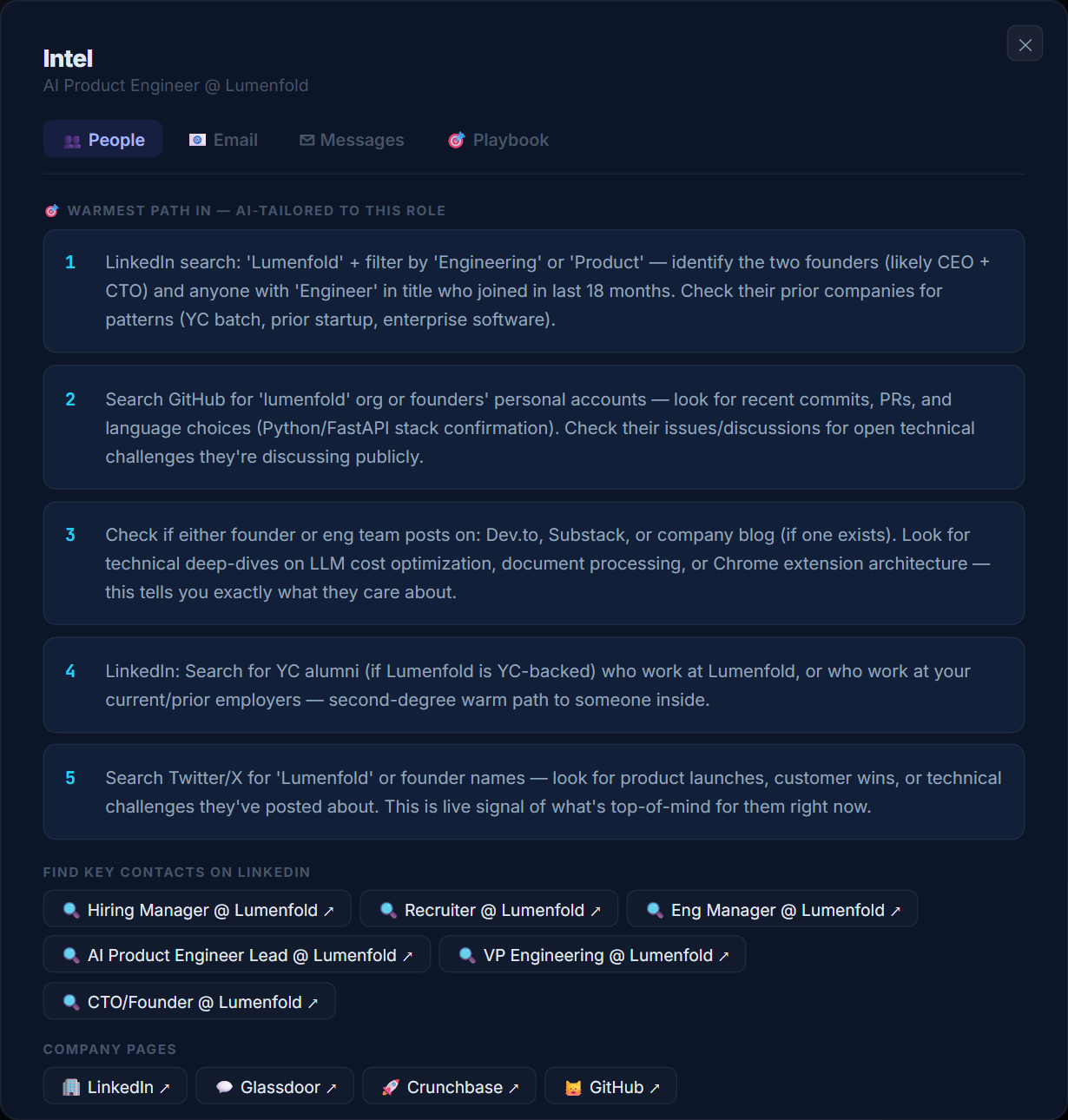
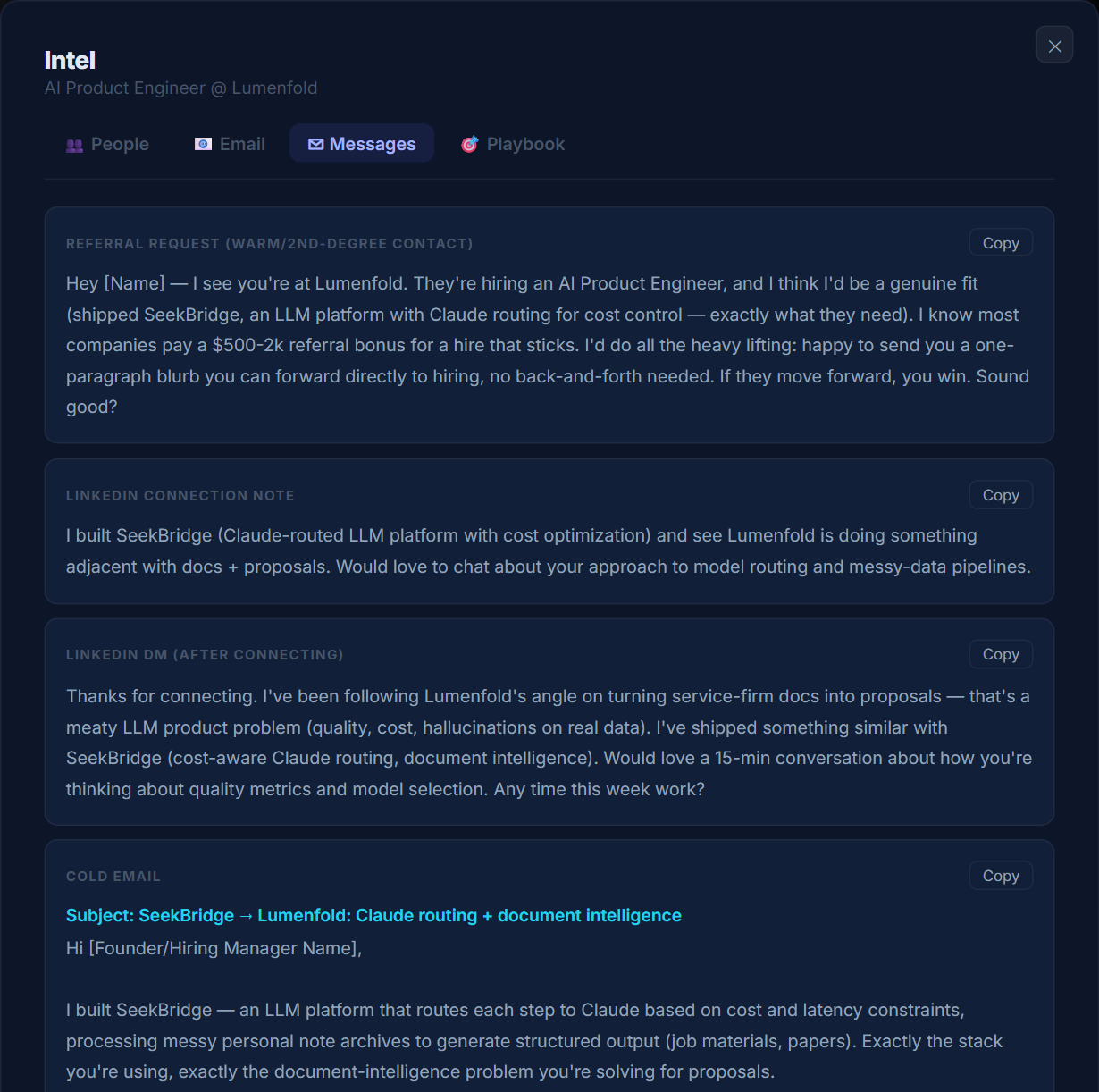
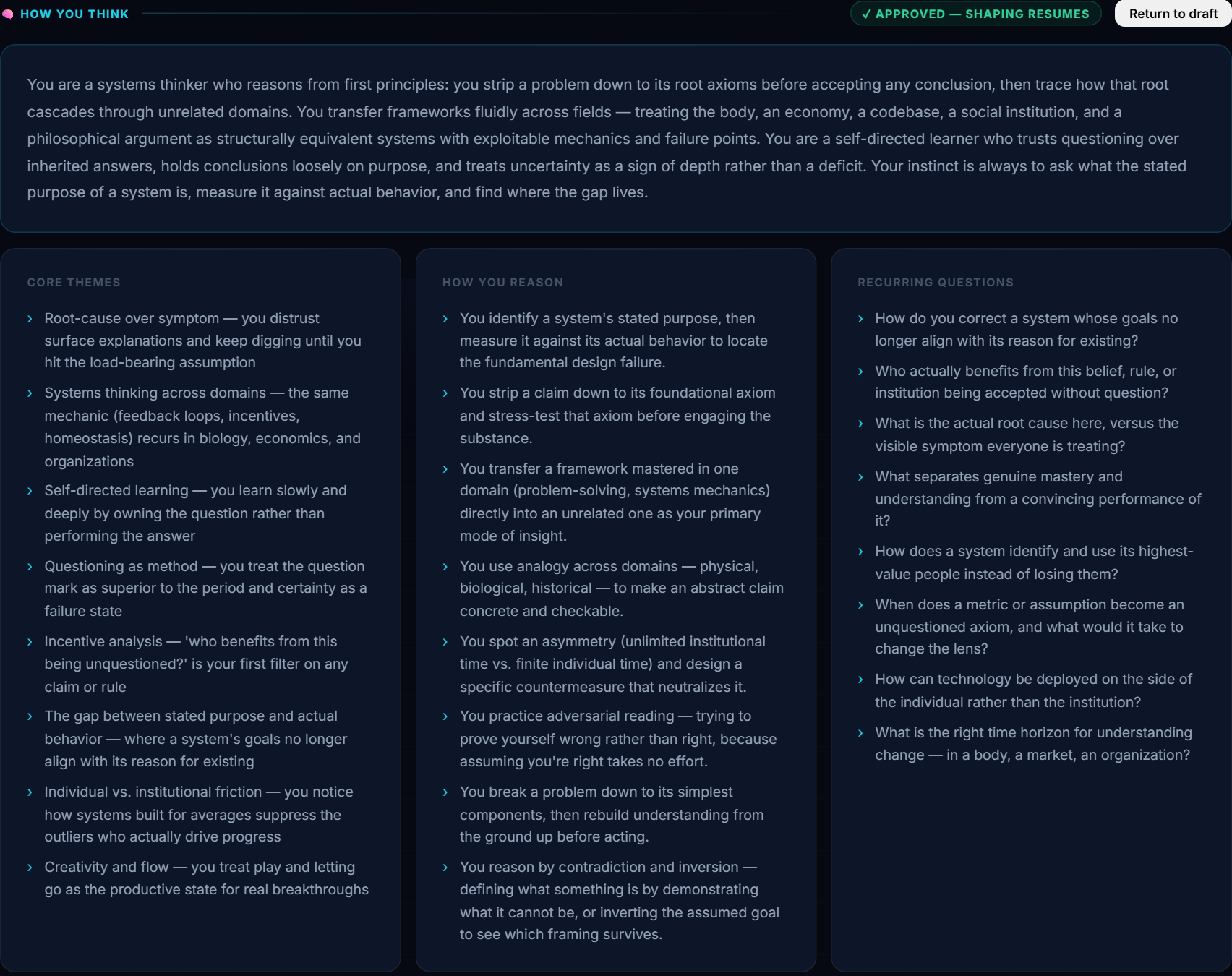
What it found in one person's notes.
These come from the founder's own vault — years of essays, poems, project plans, and old Google Docs that had never been connected.
The right model for each layer of the problem.
Not every step needs the most powerful model, and paying for it everywhere is how AI products get slow and expensive. SeekBridge splits the work into layers. Plain code does everything that doesn't need judgment. Fast models handle volume. A workhorse model reads and writes at scale. The deepest reasoning model is saved for the few decisions that shape everything else.
The result: the deepest model touches a 1,500-note vault only a few times, the layers below do the reading, and the whole connections pass costs a few dollars. Each layer's model is a setting, so the system gets better and cheaper as models do — without a rewrite.
Everything runs on what you've already written.
Vault Connections
A shared tag vocabulary built from your own tags. Synonyms merge, singletons stop stranding notes, and every note gets up to 10 tags that actually connect.
Threads
The questions, mental models, and tensions that run underneath your notes, written up as notes of their own with links to every place they appear.
White Paper Lab
Cross-subject bridges become paper topics with a thesis and outline, then full drafts cited back to your notes, saved straight into your vault.
Thinking Profile
A distilled read of how you reason, built from your essays and ideas. You review and approve it before anything uses it, and private topics are left out.
Outreach Kit
For each role: who to reach and the warmest path in, a referral request, LinkedIn note and DM, email and follow-up, and a playbook for the week. Drafts you review and send.
Job Bridge
Bring in any job, in any direction. Each requirement is mapped to cited evidence from your history, with honest gaps and concrete fixes. It never second-guesses the choice.
Honest Tailoring
Resumes and cover letters drawn from real evidence. No titles you haven't held, no invented metrics, no keywords for work you didn't do.
Fit Radar + Smart Fill
Fit badges on LinkedIn and Indeed listings as you browse. On application forms, fields fill from your profile in your own browser, and you click submit.
Gamified Dashboard
XP, levels, achievements, and rarity tiers on every job fit and paper topic. Building a body of work is slow; it should still feel like winning.
People whose best work lives outside a job description.
The Thinker With a Full Notebook
Years of essays, ideas, and arguments, and nothing published. Your body of work already exists. SeekBridge shows you what's in it and helps you ship it.
The Deep Generalist
You've crossed domains, worn every hat, built things end-to-end. Recruiters call it "unfocused." Cross-subject bridges are exactly where your original ideas live.
The Autodidact
You outgrew every job description before it was written. Your real skills live in personal projects, late-night builds, and notes you took for yourself — not in titles a manager approved.
The Career Changer
Moving up, sideways, or into a new field entirely. The Job Bridge finds your evidence for the role you want, not the one your last title predicts.
Everyone deserves a recruiter who has read everything they've written.
As AI becomes how we learn, work, and grow, the advantage won't go to whoever has the best prompt. It will go to whoever has the best record of their own thinking — and a system that can read it, connect it, and act on it. Your notes stop being an archive and become a compounding asset.
That's what a great recruiter does, and almost nobody has one. SeekBridge gives everyone one that works only for them:
Careers are where we started, because that's where the cost of being unseen is highest. But the system underneath — capture, connect, discover, draft, build from the gaps — doesn't depend on the domain. Any place people accumulate writing and need to turn it into something can run the same loop:
Founders & Consultants
Years of meeting notes, client lessons, and half-formed theses become a point of view a market can recognize.
→ thought leadership · proposals · pitch narrativesResearchers & Students
Reading notes across courses and fields connect into original arguments, and the gaps tell you what to read next.
→ papers · theses · literature mapsWriters & Creators
A back catalog of drafts, posts, and journals reveals the themes you keep coming back to, and the pieces you haven't written yet.
→ essays · book outlines · content plansTeams & Organizations
Docs, decisions, and post-mortems scattered across tools become connected institutional knowledge, before it walks out the door.
→ internal white papers · onboarding · decision recordsCoaches & Career Services
Help every client see their own evidence, then map it to the roles they want, without squeezing them into a template.
→ evidence maps · tailored materials · growth plansLifelong Learners
Everything you read, try, and reflect on adds up to a visible map of what you know, and where you're going.
→ learning paths · portfolios · personal syllabusBuilt from lived experience, not a product brief.
The current method of finding a job is a miserable, self-deprecating experience. We try to condense ourselves to a single document that encompasses our value in a few pages. We fire this document off into a system that was never designed to see us — we become a needle in a haystack. Over time the job seeker is devalued as they feel less and less.
Human knowledge, skills, and aptitude cannot be condensed down to a single few pages. Most of our best work, value, and growth occurs outside of a job description. SeekBridge solves this. We make job hunting functional, we provide a platform that empowers users, and we create value out of the things that go unseen and are commonly overlooked.
Read the rest of the story
Some of the best minds and human potential are squandered by our current employment system. I know this because I, as the founder, could not find meaningful employment that used my abilities. Thousands of sent resumes, few interviews, met with hesitation because my prior roles didn't speak to my capabilities as a human being.
So rather than become frustrated, I created a solution. Technology is meant to improve human lives — not to make them jump through hoops to survive. SeekBridge is a small correction in that direction.
Private, visible, and reversible by design.
SeekBridge runs on your machine, on plain Markdown files you own. Every change it makes to your vault is one you can see, and one you can undo.
Local-first
Your vault, databases, and drafts live on your computer. Bring your own Anthropic API key.
Credentials never leave
Notes named like passwords, or containing keys or passwords, are skipped before anything is sent.
Changes are marked and backed up
Tags go in a clearly marked block; originals are backed up per run. Drafts never overwrite a file.
You approve, you apply
The Thinking Profile waits for your approval. Applications are always submitted by you, never by a bot.
Try SeekBridge and help shape it.
SeekBridge is in a hands-on beta. If you have a pile of notes you've never done anything with — or a job search that isn't seeing the real you — I'd like you to test it. Send me a short note and I'll get you set up personally.
✉️ Email me to join the beta